

My new book – Interrogating Ethnography: Why Evidence Matters — will be officially "launched" at a conference on October 20-21. All sessions will be held at the Northwestern University School of Law, Room 887, 350 East Superior Street, Chicago.
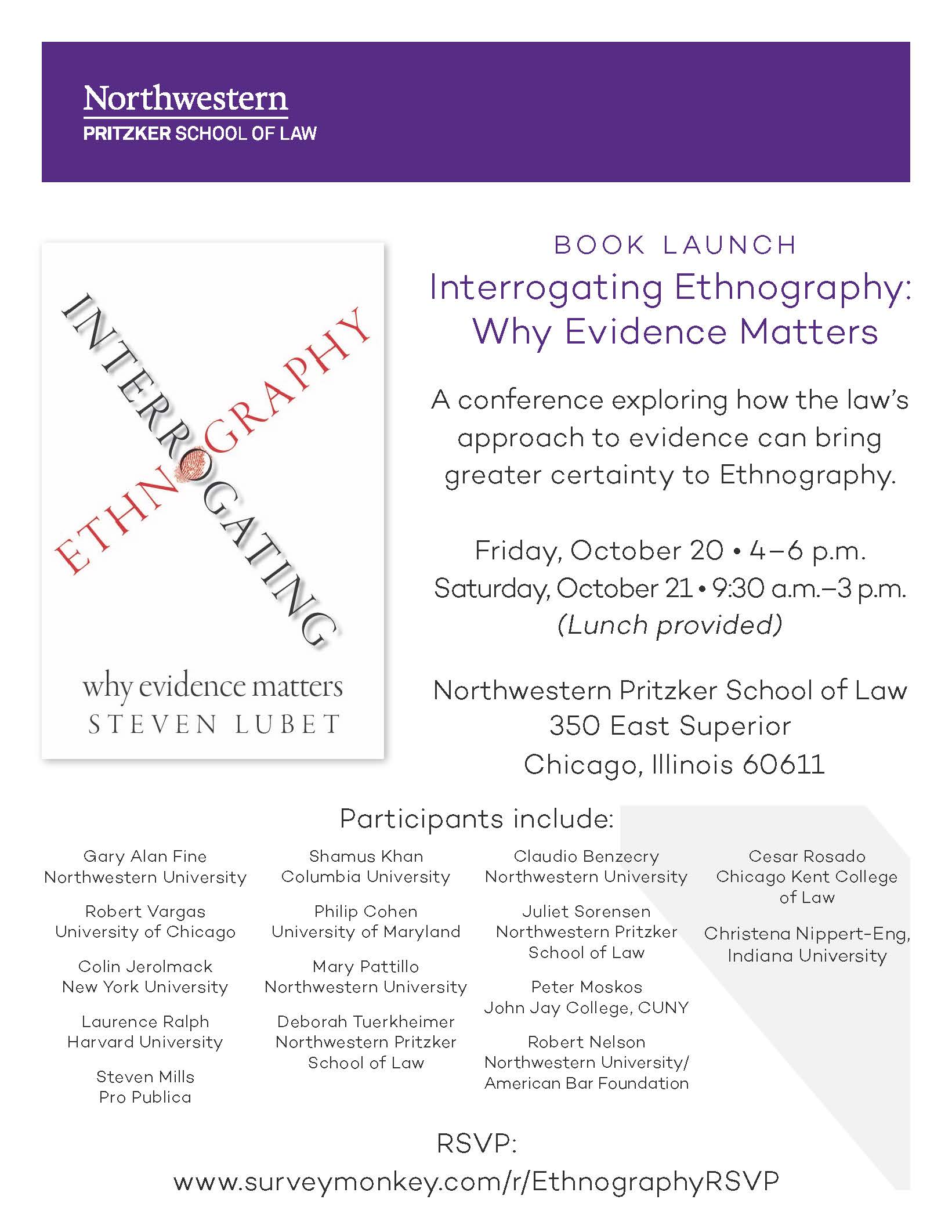
If you are in or near Chicago, it would be great to see you there for some or all of the conference.
RSVP (for lunch purposes) here.
Here is the full schedule, featuring some major figures in ethnography and sociology:
Friday October 20, 4:00-6:00 Author Meets Critics
Presider, Gary Alan Fine, Northwestern University
Presenters:
Philip Cohen, University of Maryland
Colin Jerolmack, New York University
Shamus Khan, Columbia University
Mary Pattillo, Northwestern University
Responder: Steven Lubet, Northwestern University Pritzker Law School
Saturday October 21, 9:30-11:30, Ethnographic Evidence
Presider: Deborah Tuerkheimer, Northwestern University Law School
Presenters:
Christena Nippert-Eng, Indiana University
Claudio Benzecry, Northwestern University
Steven Mills, ProPublica
Laurence Ralph, Harvard University
Lunch (provided)
Saturday October 21, 1:00-3:00 Ethnography, Ethics, and Law
Presider: Juliet Sorensen, Northwestern University Pritzker Law School
Presenters:
Peter Moskos, John Jay College, CUNY
Robert Nelson, Northwestern University/American Bar Foundation
Cesar Rosado, Chicago Kent College of Law
Robert Vargas, University of Chicago
UPDATE: The panels will be video recorded and posted on our law school website. A link will be posted here when available.
Congratulations on the book, Steve. This looks like a great conference. Will the panels by podcast?
Thanks, Al. The panels will be video recorded and posted on our law school website. A link will be posted here when available. (I have updated the post with this information.)
I see that Interrogating Ethnography is already up on books.google for those who'd like to see a preview — congratulations again. I look forward to getting a copy shortly after October 20. It probably doesn't seem this way to you, but it seems to me like you finished this really quickly!
I continue to think there is a parallel issue in methods that intellectual historians have to ethnographers: how to maintain enough distance from subjects of study. One common criticism of intellectual history is that historians impose their own framework and ideas on their subjects, so that our interpretations may have more to say about us and what's in/on our minds than what our subjects were thinking. This is an issue I spend a lot of time worrying/thinking for my pre-Civil War judges and lawyers.
Congratulations.
Great news on the book, Steve, and even better news that a whole conference will be devoted to it.
Congratulations!