

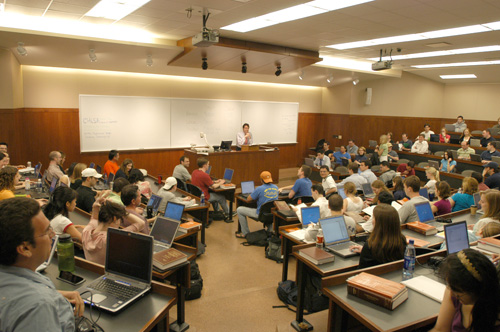
 Across the country, law professors and students are engaged in a tug-of-war over use of the laptops in class. Many faculty feel that they're disruptive – both for individual users surfing the web and for other students whose eyes are drawn to ESPN in class. They also believe that laptop use has the potential to undermine the law school pedagogy, turning active listeners into stenographers.
Students, on the other hand, feel both a desire and entitlement to use laptops. Many feel that it enhances their educational experience – serving as both a more comfortable and effective method of note-taking. They also argue that it makes outlining easier. They answer the surfing complaints by noting the long history of crossword puzzling in the law school classroom.
It seems to me that this is a manageable problem with a market solution. Limit laptop use to the back rows of class – so that surfing students won't be visible to the students who dislike distractions. And since the number of laptop seats are limited, auction these positions to students who value laptops the most. But here's the twist. Since laptops have real potential to be a social "bad", the currency of the auction ought to counter-act that bad. What could surfing students do to counteract the effects of the laptop? More work, of course!
Imagine if a professor structured the auction as follows: students seeking these seats must offer to prepare short papers in addition to the final. The minimum bid might be two extra papers, for example. Thus, in a highly competitive environment, the winning student would write five short papers over the term – presumably on topics directly related to the course material. Only highly motivated laptop users would submit these bids and any loss of education related to the laptop would be ameliorated by the papers.
What are the critiques – other than what some might see as the improper introduction of a market into the classroom? One is that some students may in fact learn more, not less, with a laptop. Three possible answers. First, these students will learn even more with their additional papers. Second, in any case, their laptop use has a cost to other students (in the form of distraction) which must be reduced. Students who learn better with pen and paper do no exact a similar cost on laptop users. More importantly, this plan is better than a flat-out laptop ban – it gives students a choice.
Another critique is that students with disabilities may need laptops and should not have to do extra work. The beauty of my plan is that these students can receive rear row seats for free (no additional papers) and their disability will be invisible to others – unlike classrooms with a laptop ban and one or two visibly accommodated students.
Of course, if the primary complaint is related to distracting surfing (rather than undermining the Socratic method), it might suffice to turn off the wireless. However as we have discovered, once you uncork the wireless genie, she is hard to re-bottle – both culturally and, remarkably, technologically.
One drawback to the plan is that the professor (who already does not want to do any more grading than she has to) now has to at least read a whole bunch of additional papers. If she doesn't read them and the students know/suspect that, then the incentive to do any real work on the extra papers disappears. Plus, the laptop seat is going to be earned only on a *promise* of writing the papers–what if the student does not follow through.
The other question goes to your final premise: Is turning off the wireless really an option? At least in our building (and I suspect most others), the wireless is building-wide, not classroom-by-classroom. It is impossible to turn off the wireless in any one classroom; there always is a wireless the computer could find (which is why I can get wireless in my office, in the hallway, in a classroom, or in my colleague's office). Or am I misunderstanding the technology?
Howard, the technology issue I'm referring to is exactly that: once you have wireless in the building, it's very hard to turn it off in selected classrooms. (But I've heard that some schools – including UCLA – have managed to do so.)
I reserved the right to ban laptops if class participation dropped too much for my taste – all at my discretion. I had no complaints from the class for that "threat" and class participation has been great. As I started using powerpoint in my class, I was worried that giving out the powerpoints would drop class attendance. But, I also found that if I gave out the powerpoints then the use of laptops actually decreased. So, I now give out the powerpoint at the end of the week. But, I also use the NFL blackout policy – if class attendance drops below 97%, I don't give out the powerpoint slides for that particular class. It has worked out really well.
Let's see, Dan and Stew, who pays your bleeping salary? Oh, that's right, my tuition (not to mention my taxes). And whose private property is the laptop? Why that would be mine. Oh, and as for turning off the wireless? That's what I have a Verizon aircard for. Going to try to jam the frequencies?
My experience through undergraduate and Master's programs was that the worst professors had the most draconian class attendance policies — glad to see you continue that tradition.
Love the idea.
SDN: You went to school expecting to learn. Not surf the web. You obviously didn't consider their suggestions. Rights and privileges must be earned, never handed out. Same goes for regulations, there must be a specific reason for em. And they did offer counter offers and frankly, with our generation still not getting over the 'me and only me' crap, I give props to them finding a way to cut our generation to size.
If you don't want to earn a grade, don't go to class. Stay in your local Starbucks and surf the net. Besides, penmanship has gone down in recent years. This might b incentive to either write better or have an eye in deciphering a squiggly line that somewhat resembles a word.
Geez, the whining on this issue is stunning. i used laptops all through undergrad and law school. i was entitled to, under the ADA. i never harmed anyone's ability to concentrate.
Really, if me checking the news in class harms someone's ability to concentrate, something else was bound to get them. A woman in a low cut dress… a unique T-shirt… someone's doodles… something…
as for the fear that kids will just write everything down… or maybe people will spend less time writing, because they can write faster and thus they can devote more of their attention to listening than writing.
How about this for a change? Treat us like adults. We spend alot of money to be there. We know how we learn better than anyone. Especially in law school where any schmuck with a J.D. is qualified to be a professor, the claim that the professors know better so they can say that 100% of the class is worse off with laptops is just silliness.
I'd just like to point out for the people who want to use a laptop because it saves them significant amounts of ever-so-precious time, and without that time saving they would likely struggle to finish their work at all (e.g., because they read slow but don't actually have a disability requiring accommodation, or because of non-school obligations, or for any other reason, really), your so-called solution is instead a kick in the teeth.
Pardon me if I find the solution unsatisfactory for the blatantly obvious "fairness" reasons. People who most desire to be *able* to pay are, by the very nature of your auction, the ones *least* able to participate.
The assumption that people wanting to use laptops during class want it for web-browsing purposes is, quite simply, flat out wrong.
SDN and Aaron's attitude is one that unfortunately we see more often these days. Rather understandable given the high tuition and all, but still very badly reasoned. If you think you are "entitled" to do whatever you want because the professor is somehow indebted to you for their salary, then logically you would also be entitled to not prepare for class, not answer questions, and not take exams. And if you think that the professor cannot know better than you because "any schmuck with a J.D. is qualified to be a professor," then why are you taking classes from said schmuck? Again, if professors really did not have better knowledge, then you should be entitled to not answer their questions, and not take their exams, which I think nobody yet as gone far enough to argue. Some degree of paternalism goes hand-in-hand with the fact that this is a school we are talking about.
Needs to be reversed – start with the teaching earning 0% of their salary, and let them buy up to 100% by trading away pretensions. If a teacher wants to the front 3/4 of the class laptop free, well that's worth ~50% pay. Deduct money for skimming when grading, for arriving late, for canceling class or having unqualified subs. If a teacher has a problem with students arriving late or talking in class, the teacher should take a 10% pay cut.
Or, you could learn how to *actually manage a classroom while teaching effectively.*
Iphones and Laptops are all over my classrooms, with zero disruptions — use it for legitimate purposes? Great. Use it for facebook? Lose your privelege. Similarly the "war on cellphones." STanding policy: if the student has a legitimate reason for checking a text (you have children or you're on call), go for it. If not, and you're just addicted to your "thumbs of power," you get mocked and told to put it up.
Results of basic classroom management skills that actually treat students like adults? All of this tempest-in-a-teacup becomes a complete nonissue.
You can't be serious that this is still a debate in 2010. When I was a law student from 1995-1997, I used a laptop every day in class and even tried a newton for a period of time. This isn't about "being too busy" (Do you own a cell phone that can check email, Professor?) or disruptive or the ability to ignore a windbag in favor of a little illicit web browsing. It's about efficiency and superior note-taking. If only a wiki/notebook/outliner like Wikidpad had existed then.
Any professor that has a problem with students availing themselves of such a bedrock information technology in 2010 should be offered a choice between mandatory retirement and publishing a paper explaining exactly how their personal antipathy to everyday technologies help prepare students for the real world.
Such papers could serve as both entertainment and a warning to prospective students, especially those who cling to the romantic notion of pursuing a career in the bubble of academia.
novel idea: folks who use laptops to their own detriment by surfing in class learn less and do poorer
I'm not sure why that's not incentive enough
I don't pay >30,000 a year to have some professor complain about class participation when he/she reads directly from the tax code. Laptops are not the problem, you are. Get over it.
Generally Professors Grade one of three ways:
1. Their examinations are based entirely on material covered in class, or
2. Their examinations are based entirely on material covered in a book they wrote.
3. They do not have examinations, but instead will grade your paper.
In situation 1, a computer is a competitive advantage if, like most of us, you can type an outline faster than writing one, or have auto-synch software. Since success is based upon having an accurate transcript to review of the exact material to be covered. In situations 2 and 3, paying attention in class is not necessary so using a laptop is neutral.
Banning laptops, except for those with disabilities, creates an incentive to cheat, and get a doctors note prescribing laptop use. The cheaters have an advantage prohibited to most of the honest. It is similar to cheaters who get extra time to take exams, or who only study for 3 of 4 classes and get a doctors note excusing them from the missed exam at the end of the year so that their GPA on the 3 classes is higher to position them better for OCI – Seriously, I know brilliant lawyers who used this strategy.
Let's be honest, most academics lack any backbone, if they had one they would be in private practice. Cheaters, especially ones armed with doctors notes, will never be punished, so why set up a situation to disadvantage the honest?
The alternative is to simply let everyone use laptops, and allow those nincompoops who cannot handle them to fail. That would be a true market based solution, not one that tailors your lessons for the lowest common denominator, and allows for cheaters to have an advantage. However, this latter economic system has been warmly embraced by the White House for years, so who am I to criticize.
32k = I can use a laptop. You want to make sure people participate in the discussion? Do a better job. I've had classes where laptops are allowed and the professor keeps the class engaged. That's what good professors do. Unfortunately some professors think that external factors should be changed instead of their style, because they couldn't possibly be the problem. For as much as some professors expect out of their students, students could expect at least as much out of their professors.
A few points:
1.) Adopt the University of Chicago system of disabling wireless classroom-by-classroom. Goodness knows if we can do it in our terrible building, you can figure out how to do it in yours.
2.) This "distracts other students" argument is ridiculous. Look around your classrooms, professor – how many people still use a pen and paper to take notes? 2, 3 max? The number is generally "0" in my classes. Doesn't justify the serious harm you're doing to students who can far more effectively study and prepare for exams using their laptops.
3.) If you are honestly concerned about people being distracted by the wonders of the internet – how in God's name are these easily distractable people going to function in a modern-day law office? Better that they learn basic ability to focus in school.
4.) If class participation is truly awful, perhaps you should look at your own pedagogy. With a few exceptions, the professors I have had are all horrible teachers, though brilliant people. Perhaps you also fit the bill. Good teachers don't have to worry about students not paying attention.
If your class is so boring you can't keep a student's attention for 40-60 minutes, that's a problem. Students worried about being distracted by other people's internet surfing can sit in the front row. In most of my law school classes we had theater seating (back rows elevated), making the back rows inaccessible to disabled students. In my experience as a teaching assistant in law school and an English teacher after college, I never had a problem keeping students' attention so long as my classes were interesting and engaging. This takes work. Several professors I have had over the years were successful at this. Many were not. When will teachers realize that when students don't pay attention in class it isn't the fault of the students, of laptops or of the internet, it's the fault of the teacher? If professors were a little more self-aware and less arrogant about their positions maybe they would improve their teaching rather than malign laptops in the classroom. Of course this requires doing more than just reading the same outline to students year after year after year. I expect the worst performing teachers hate laptops in their classrooms while the best performing probably welcome them or at the least are not bothered at all. Rather than shun from progress why don't you use the laptops as an educational tool, distributing slides, examples, analysis, questions and the like that track your lectures for students to look at during class?
Having gone through undergraduate and graduate school never having even heard of this debate over laptops, I was simply amazed to find out about it when I entered law school. It never crossed my mind that a professional school, full of adults, would even consider limiting students’ options for learning. For that matter, I could hardly believe that the ABA and professors have attendance requirements (but this is another debate). I am an adult. I am paying tuition. I can manage my own learning. The only valid argument that I can see on this issue is the disruption to the learning process of other students. But strangely, it is only professors who talk about this. I have never heard a student complain about being disrupted.
As for the class participation arguments and the like, I am convinced that professors with this view are the most self-absorbed people in academia. They demand that we attend their classes and participate in a certain way, while at the same time putting little or no effort into class preparation and student feedback. Again, I am an adult. Why is that it is only law schools and law professors that have not figured this out?
It seems to me there is significant tension in many law schools, including the University of Chicago, between banning the Internet in class and the increasing required use of electronic means for functioning in law school. Important schedule changes, course documents and assignments, many things that are relevant to the academic enterprise, are only available through the Internet. If there was a convenient way to, say, allow access to school e-mail, Chalk and law school-related websites while disabling Facebook and TMZ.com, I'd consider that an acceptable compromise. I don't think professors should be in the habit of extensively using the Internet to distribute class materials and assignments, but then forbid Internet entirely in class. As it stands now, I'm somewhat grateful for the professors who don't use the Internet for their classes much, because I don't feel as much at a disadvantage for lacking Internet during class. That doesn't address the larger issue of law school communications as a while, however.
I hate the auction idea. I never sit in the back of the room unless I have no choice; forcing me to sit in the back if I want to have the use of my laptop is much more likely to send my usual level or class participation into a tailspin. I also feel I get much more out of a brief in-person interaction with a professor than I would out of writing an additional short paper. Writing a short paper is, fundamentally, self-directed learning. If a professor expects me to learn more out of class writing a paper than I do in class listening and interacting with the professor… that's a really expensive law correspondence course. The auction as proposed also disregards the significant inequalities between classes. The same professor in different classrooms may have vastly different sizes of back row, and therefore the scarcity of laptop-approved seating is varied. Likewise, classes with more students with disabilities become less laptop-friendly for everyone else, because they're taking up some of that space (assuming the back rows are, in fact, accessible to those students.) This could even lead particularly laptop-oriented students to choose classes based on avoiding classes with high numbers of students with disabilities, which can't be a good set of incentives for anyone involved, including the professor or the law school.
How about the fact I pay over $50,000 to go to my law school. I should be able to do whatever the hell I want.
This is not a well thought-out suggestion.
How would these 5 papers affect the students' grades? Would they be averaged in with the exam? I think a lot of people would PREFER to have their grades based on 5 papers in addition to their exam (so their exam would not bear so much weight on the final class grade).
So you'll end up with people who don't even care about laptop use bidding for these seats just so they can write the papers.
Idiot.
I love to hear these debates about laptops in the classroom and the heated back and forth. I'm currently a law student; I don't use a laptop to take notes in class. From what I've noticed, I'm one of maybe ten students in the entire law school who isn't tethered to a computer during class. Its nice to sit back and truly not care who wins in a debate.
As a student who needs to use a laptop because of a disability (hearing — try reading lips and handwriting notes at the rate most professors talk!) I would be incredibly uncomfortable in your class with that policy. I use a laptop because I can't hear, which is the same reason I show up to class an hour early on the first day to get a seat close to the front. Maybe I am arguing that your rule would harm only students who are the exception…but aren't you only proposing this rule because of students whose distraction is the exception?
Law school is a professional school. If you believe (as I do) that the ability to pay attention is invaluable in this field, then base your final evaluation upon class participation / class material rather than just the reading. At the very least, don't punish the students who depend on technology to succeed because of a few knuckleheads.
You may also want to consider setting up an anonymous complaint system for people who are distracted by others during class. Most shopping / crossword puzzling doesn't bother me, but I would gladly have (anonymously) ratted out a kid who sat inches from the professor in a stadium seating lecture hall watching actual video footage of soccer matches during Property. Knowing his peers could call him out might have deterred such obnoxious behavior to begin with — or at least drive those who plan to surf the web to the back of the room.
"The only valid argument that I can see on this issue is the disruption to the learning process of other students. But strangely, it is only professors who talk about this. I have never heard a student complain about being disrupted."
I complain about it all the time. In fact, the most distracting thing is the incessant typing from all directions. It is thoroughly distracting (not to mention annoying), and the proposal doesn't deal with this externality.
As a current 1L at a top law school, I'm inclined to support the outright prohibition of laptops except in special situations (disabilities). I'm not sure it would hamper class participation all that much; the socratic method generally requires active listening in the event one is called upon to respond (if its voluntary participation, that's different and you've got more fundamental problems than a laptop policy, imo.)
I do believe that their use is distracting to both students who use them and other students. Given seating charts (a necessity in large classes with a socratic style), it is difficult for students to avoid being distracted by other laptop users, especially when it is the typing sound itself that is problematic. I would justify the ban simply to prevent this distraction from injuring fellow classmates, unless their was unanimous consent by the class members and professor to their use.
Finally, as for other arguments regarding the "effectiveness" of a teacher at maintaining a class' attention, the argument that this can be done by "good" teachers is an argument I generally have heard espoused by those teachers who care more about being popular with their students than imparting any real wisdom/education. There are always going to be students who are more interested in something other than what is happening in class and the use of laptops enables that, no matter how engrossing your lecture or other "activity" might be. While this applies less to the law school setting, if you are teaching High School English, it is quite clear that you owe an even greater duty to your students to prevent the use of laptops and other distracting devices in class.
I don't institute a laptop ban in any of my classes. But I'm surprised by the amount of self-indulgent whining in the comments here, from people who claim to otherwise be mature adults. We're talking about how best to create a learning environment — something that is directly within the professor's job description. To get this upset over the possible temporary deprivation of what is essentially a fancy note-taking tool (as used in class) is a sign of profoundly skewed priorities.
Professors, remember who you work for. That would be us, the students out in the classroom, typing away to try to keep up while you talk. There are a few of us who use the laptop to surf, do crosswords, etc, but those will soon fall by the wayside.
There is a simple solution to Professors who think a student is being disruptive in the classroom. Give them their money back and allow them to leave. If you are not willing to give their money back (and I mean all of their money), then all you are doing is whining. We *hire* you to teach us, we *pay* you your salary, you may establish whatever weird and odd classroom rules you wish (all students must wear a red rubber nose, anyone bringing gum must bring enough for the whole class), but never lose track of the fact that you are an *employee*, not a King.
just an aside – technology is about to eliminate the possibility of restricting wireless in one particular room of the school (yeah, you, UChicago). The FCC just approved new bandwiths that will make wireless available *everywhere*. That panera or mcdonalds down the street will provide WiFi even if the school's network doesn't. not to mention the fact that people increasingly have 3G or 4G wifi access through their cellphone plan.
so, professor, best focus on a realistic teaching solution. being interesting is a good start.
as an aside, if i have to work with one more 60 year old attorney who doesn't know how to use the damn markup function in MS word, i am going to lose it. okay, no i'm not, because i deal with these nincompoops every day. they live in the stoneage, waste my time, and waste their clients money. (stop changing the font to red colored slash text – just turn on the darn "mark changes" function).
Recent grad here. I think the real problem is that law students need to grow up before they attend law school. 30% have no idea why they are there so they surf the web looking for answers. 40% still think it's senior week so they search for more facebook friends to talk about starting thirty thursdays on wed. This combined group of 70% are the ones crying here in the comments and have the maturity level of a pre-teen cheerleader. Really, the maturity level, the lack of professionalism, and the lack of real life experience is the problem.
The remaining 30% of the students are there to learn, will act respectfully and professionally, and will use their laptops responsibly. So here is my solution: figure out who the qualified 30% students are, allow them to use their laptops, and then tell the other 70% they're stuck with their Transformers Trapper Keepers.
Honestly, most law students just aren't ready for law school, or the profession.
The "market price" should be taking and sharing comprehensive notes of the class, and if your notes are worthless then you lose your seat. That way it benefits all of the other students, unlike writing a bunch of papers that are not useful to anyone
If law school professors really cared about students learning then they would do more than one single final exam at the end of the semester. There is a mountain of research that states that constant feedback truly enhances learning and understanding. So where are the weekly quizzes? Where are the assignments where students can practice drafting contracts in contracts class? Why can't law students write several papers which GOOD feedback and a solid critique by the professor during the course of the semester? If you really cared, the issue shouldn't be whether or not laptops are distracting; the issue is why law school professors are so lazy as to only have a SINGLE final exam at the end of the year, or a SINGLE paper. Sure that would be more work for the law school professor, but so what! High school teachers grade and give constant feedback throughout the year for a third of the salary. I call bullshit on y'all law school professors. Bullshit!
You went to school expecting to learn. Not surf the web
Quite frankly, if your ability to teach (and your students' ability to learn) are threatened by individuals who use laptops, I question your ability to teach. Please leave the profession and do something you're qualified to do (i.e., man the register at McDonalds). Fot those students that are bothered by laptop use, move elsewhere. And please turn in your driver's license as you're a menace to society if you're that easily distracted.
At a minimum, these students (who all pay to attend law school and as such, law schools should be working incredibly hard to make sure their 'customers' are given (yes, given) the tools needed to learn, not learn in the 19th century) may be more efficiently using their time, actually participating in class while surfing the web, and scoring high grades. I know – I was one of them. I also chose to sit near the front of the class so that I could see the illegible scriblings of professors who failed to use techonology properly – which I could not do if I was 'banned' to the back of the classroom. As for having to write papers – all for it so long as those that chose to hand-write were required to pay a penalty by not electing to write additional papers (i.e., the graded papers should count for extra credit, not as a demerit).
As for the students who don't do well (ostensibly b/c they couldn't concentrate b/c they were "distracted" (by the activity of others or their own), there's an easy solution – fail them. They'll quickly learn how to not be distracted. If you're incapable of doing so – either b/c you do not have the courage to fail students or your school's grading policy prohibits/restricts it – that's your problem. Punishment should fit the crime and using a laptop isn't the crime, failure to do the work is.
Attempting to use classroom attendance as a proxy for learning material is likewise quite stupid. If the lectures were useful in learning the material, then students would attend. If attendance drops, it isn't b/c a PPT deck was handed out (properly constructed decks should not equal perfect answers on law school exams) – it's b/c you're failing your students at teaching. Again, go flip burgers as it seems that's what you're qualified to do.
Professors who blame laptops instead of their own abilities are the reason why we have such a poor educational environment. What world are these professors training students for? It really boggles the mind that they manage to wake up and function on a daily basis in today's society.
I'm a law student at UCLA, and I'd like to (gleefully) share that a lot of us have access to internet bc a lot of students can "tether" wireless connections via 3g devices. Necessity is the mother of all invention…
So this is the state of higher education. Good lord.
I have an idea. E-mail your lecture notes so people don't have to take notes. If you're afraid people will not come to class, and you don't know how to manage it, you don't belong in front of a class room.
As for distraction, tell the complaining students to fix it, or speak up and you will help them fix it. They are adults after all. And if someone is distracted by typing, they will never last in the real world.
This post is disgraceful. I have another idea. Why don't we ban conceited fools and allow technology and mentors to replace them while students earn a wage?
An interesting solution. I also never considered the stenography v. critical thinking distinction but I am now concerned. indeed there was a class I took last semester taught by a great professor but in such a way that required stenography-type note taking. I wonder if that same class taught by the same professor would have been taught fundamentally differently a decade or so ago when laptops were less common.
This is why my firm and many others are not interested in hiring new or recent grads – you have not been educated properly.
No laptops should ever be allowed into any law class, no exceptions, period. Screw your ADA whining, if you can't cut it then you don't get to be a JD.
When you come into my class, you sit down, shut up and prepare to be educated by taking out your notebook. It is called a notebook because that is its intended use – the taking of notes. I need to watch you taking notes and of what, when, and when you stop. PART OF MY SKILL as an educator is knowing when I haven't made myself clear – note taking stops, students look up with the deer-in-the-headlights expression and tap their writing instruments. It is my power of observation – maintaining eye contact with students while I orate – that gives me this immediate feedback. THAT'S what you are paying me for, otherwise you may as well be going to Abe Lincoln online.
All this touchy-feely BS is why even T10 schools churn out mostly useless self-entitled drones who do not have the skills or discipline to be competent attorneys.
Dismissed.
"Screw your ADA whining, if you can't cut it then you don't get to be a JD."
Well that sounds like a defensible legal position from the asshat generation that turned the law into a lottery for professional complainers and their greedy shepherds.
"When you come into my class, you sit down, shut up and prepare to be educated by taking out your notebook. It is called a notebook because that is its intended use – the taking of notes."
This is why the legal profession is lodged in an expensive, unproductive 19th century model that only a 2nd Empire French Bureaucrat would recognize. This is why Lexis Nexis and Westlaw haven't changed significantly in 20 years: Utter technological incompetents that maximize busy work by viewing the computer as a glorified typewriter for secretaries. No wonder your industry is collapsing.
"I need to watch you taking notes and of what, when, and when you stop. PART OF MY SKILL as an educator is knowing when I haven't made myself clear – note taking stops, students look up with the deer-in-the-headlights expression and tap their writing instruments."
He's right here: Volumes of research by Windbag, Pettibound and Doosh have demonstrated the power of laptops to compel students to keep typing or even avert their eyes from the screen when confused.
"It is my power of observation – maintaining eye contact with students while I orate – that gives me this immediate feedback. THAT'S what you are paying me for, otherwise you may as well be going to Abe Lincoln online."
We'll have to use our lesser powers of observation via the inter-tubes to appreciate what it must be like to experience the arrogance of this autocratic and capricious windbag in person. Your power to "orate" could be replaced with a 10 minute video on YouTube. Deal with it.
-Reversed and Remanded for lack of competent jurisdiction.
there is no need of laptop . all class will be tweeting teachers lecture
Here's a market solution: Why don't professors teach better so that students, who are paying upwards of $30,000 a year in some cases, feel that their dollars are better spent listening rather than playing farmville?
If a student wants to waste that time and money surfing the web, let him do it.
Besides, he's probably looking at Wikipedia; usually, it makes more sense of the cases than the casebook or professor does.
This might actually be the dumbest idea I have ever heard in my life. It's one thing if one student's internet usage is disruptive to another. That is a legitimate gripe relating to laptops. However, wouldn't it just be simpler to suggest that the offended student approach the other student and politely, but firmly, inform him that his internet usage is disruptive and request that he refrain from doing it? I mean, seriously… Why is it that a professor should have to behave like a pre-school teacher and punish an entire class for the acts of a few? Why should one person have to ruin it for everyone, when the issue could have been resolved by two grown-up students?
Furthermore, this whole "auction" idea is truly asinine. It would certainly seem to favor wealthier students, namely, those who are there on mommy's and daddy's dime and could conceivably afford to pay anything for one of the back-row seats, while a poorer student who has equal desire, or even need (let's say he has extremely poor penmanship, made worse by the frenetic pace of taking lecture notes), to use a laptop would be at a clear disadvantage. Worse yet, Dean Filler offers to combat this issue by compounding it with an even dumber idea, that of giving extra work to laptop students. Competition for grades is cutthroat as it is, and it would be easy to foresee students who were given more work and receive lower grades screaming bloody murder. Law school grades and competition are tough enough with a purportedly level playing field, let alone one that is intentionally made not to be level.
Dean Filler, you may think you're novel and creative, but really, you just need to grow up. Tell your students that if another student is offending them with their laptop usage during class, they can resolve that amongst themselves. Why students would even "tattle-tale" on other students in the first place (or why a graduate school professor would even allow this) is truly beyond me. Oh, and if YOU'RE the one offended by such use, you should remember that law school isn't about you. It's about learning the material, and about a tuition-paying student's right to learn that material (or not learn it) in whatever way he sees fit. At the end of the day, the student is the one who has to take the exam, pass the bar, and rely on his knowledge in practice. For any professor to claim that a student's inattentiveness due to laptop usage is any skin of their nose is utterly absurd. Go back to boring your students, because you clearly aren't a policy whiz.