

 Via Bloomberg:
Greece accepted an unprecedented bailout from the European
Union and International Monetary Fund valued at more than 100 billion euros
($133 billion) to prevent default, agreeing to budget cuts that unions called
“savage.”
The measures are worth 30 billion euros, or 13 percent of
gross domestic product, and include wage cuts and a three-year freeze on
pensions, Finance Minister George Papaconstantinou said in Athens today.
Greece’s main sales tax rate will rise to 23 percent from 21 percent.
Looking back at our Lounge posts on the topic, I see that we
first blogged about the looming Greece crisis on January 3 of this year,
and have been covering it ever since.
Now Greece has been bailed out and, sadly
for Gulati, the exact terms of those debt contracts appear likely to
forever remain an item of purely academic interest.
So are we done now?
Game over? I suspect not,
and am left with even more questions now than when we began this endeavor four
months ago. Hopefully, our
informal counsel of sovereign debt experts will be willing to convene one last
time to answer some of them.
1.
1. Where does this leave the other PIIGS (make
that PHIIGS) now? Yields surged on Portugal, Spain, and Hungary last
week. And it’s not clear that the
Greek bailout should magically restore market confidence in those countries’
ability to repay. Will another European
shoe drop later down the road? (I’ll
leave aside non-European high-income countries for the moment, such as Japan,
whose debt is projected
to climb to 227 per cent of GDP by the end of next year.)
2.
2. If so, what does that mean for the European Monetary
Union? Presumably, engineering a
bailout for another country sometime down the road will be even harder, as both
an economic and a political matter, than this one was. After all, Germany, the IMF, and everyone
else who participated in this bailout will have less money to spare now, and domestic
political opposition, particularly in Germany, has been intense.
3.
3. Can Greece even implement these severe austerity
measures? Bear in mind that this a
country in which one
out of every three people is employed in the civil service, which until now
has guaranteed jobs for life, and each prior mention of austerity measures has prompted
massive nationwide strikes and protests. Notably, there has
been no mention yet of whether the government would relax rules on laying
off public workers. To make
matters worse, it appears that the rich have been
avoiding taxes to the tune of $30 billion a year, which can’t sit well with
the Greek working class, who perceive (no doubt correctly) that they’ll bear
the brunt of any austerity measures.
4.
4. Finally, what is the Greek economy supposed to
look like at the end of three years when the aid runs out? Can the economy really grow in the face
of such severe cuts? Or is this just
a short-term (and expensive) fix? For
those wanting a more in-depth history of the Greek economy, Tyler
Cowen linked yesterday to a paper documenting when the Greek economy
started downhill, The Two Faces of Janus: Institutions, Policy
Regimes and Macroeconomic Performance in Greece, George
Alogoskoufis, Economic Policy, Vol. 10, No. 20
(Apr., 1995), pp. 149-192. (The ungated copy is here).
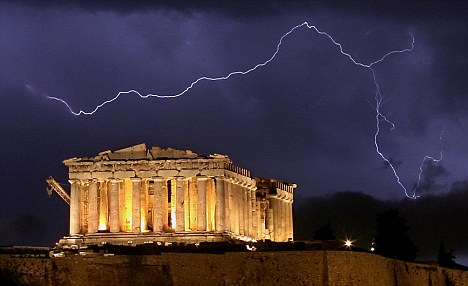
Image Source: Daily
Mail
Related
Posts:
The
Greek Bailout: War Versus Dishonor
What
Do Those Greek Debt Contracts Say?
Greece:
Argentina, Uruguay, or Twin Engine Plane?
Blame
It On Derivatives, Blame it On Goldman Sachs, Blame It On the Nazis. But Don’t
Blame the Greek Crisis on Greece
The
Greek Crisis: Economic Meltdown or Mental One?
The
Modern Greek Drama: Comedy, Tragedy, or Both?
The
Modern Greek Drama, Part 2
Verge
of the Unböring (The Modern Greek Drama, Part 3)
Is
2010 The Year of Odious Sovereign Defaults?