

 Well, the SEC
complaint against Goldman Sachs has thwarted my resolve to refrain from
blogging until classes end in a few days in the hopes of actually getting some work
done. And, of course, I can’t stand to be the only person in the blawgosphere
with nothing to say on the issue, especially when I’ve spent a good chunk of my
career teaching and researching disclosure duties (see, for example, this empirical
study with Kathy Zeiler on the duty to disclose at common law).
Let me say at the outset that, perhaps unsurprisingly, the
bulk of the media coverage in my opinion misses the primary issue in the case,
which has – or should have — nothing to do with the fact that a major client
was shorting the deal (which is inherent in the synthetic CDO structure), that
the client was speculating rather than hedging (an obvious possibility,
especially by 2007), or even that the client was Paulson or any other
well-known bear. Sure, this latter
fact seems relevant now, with the benefit of hindsight. But, as
Larry Ribstein points out, in early 2007 much of the market was still
betting against Paulson’s view that CDOs were underpriced relative to their
risks.
Instead, the real question, as
already noted by Erik Gerding, is whether Goldman’s failure to disclose to
investors that Paulson, based on his analysis of which securities were likely
to be downgraded, had been involved in picking the specific securities
comprising the CDO portfolio, and, in fact, had been allowed to veto the inclusion
of particular issues. It seems to
me that the SEC’s case in this regard is not a slam-dunk, nor is Goldman’s
defense of it. In other words, it
looks to me to be a rather hard case, whose outcome will depend on the ultimate
resolution of several underlying questions.
Was Goldman’s failure to disclose this information to
investors a material omission? I think that’s a real possibility. The Abacus
flipbook contains by my count 29 pages (nearly half the content of the 66
page flipbook) of disclosure on ACA as Portfolio Selection Agent, including information
on ACA’s business strategy, investment philosophy, senior management team,
asset management organization chart, and the ACA-ABS credit selection process
and criteria, with a good deal of emphasis on ACA’s prior experience as a
portfolio selection agent. Nowhere
is Paulson’s role in the selection process mentioned. It’s plausible that a reasonable investor, even a sophisticated
one, could have taken this information to suggest that ACA exercised independent
judgment, expertise, and diligence in selecting the CDO portfolio.
The next question is whether any countervailing disclosures
might reasonably have quelled that false impression. Jeff
Lipshaw correctly notes that the Abacus
flipbook contains disclaimers and risk factors, which prominently note the
following:
·Goldman
Sachs may, by virtue of its status as an underwriter, advisor or otherwise, possess
or have access to non-publicly available information relating to the Reference
Obligations, the Reference Entities and/or other obligations of the Reference
Entities and has not undertaken, and does not intend, to disclose, such status
or non-public information in connection with the Transaction. Accordingly, this presentation may not
contain all information that would be material to the evaluation of the merits
and risks of purchasing the Notes.
· . .
. Goldman Sachs is currently and may be from time to time in the future an
active participant on both sides of the market and have long or short positions
in, or buy and sell, securities, commodities, futures, options or other
derivatives identical or related to those mentioned herein. Goldman Sachs may have potential
conflicts of interest due to present or future relationships between Goldman
Sachs and any Collateral, the issuer thereof, any Reference Entity or any
obligation of any Reference Entity.
·Goldman
Sachs & Co. will act as the initial purchaser for all classes of Notes, and
affiliates of Goldman Sachs & Co. will act as the Protection Buyer, the
Basis Swap Counterparty, the Collateral Put Provider and the Collateral
Disposal Agent.
Are these disclaimers sufficiently specific to overcome any
duty to disclose the involvement of Paulson that might have been created by
Section II of the flipbook? Though
that’s a possibility, I think the answer is probably “no.” These are quite generalized
boilerplate that are probably not sufficient to negate any false impression, if
indeed there was one, created by the remainder of the flipbook disclosures on
ACA. Perhaps the Offering Circular
(I have not seen it – the SEC complaint says that it is 178 pages) contains a
more detailed disclosure, though I suspect not — Goldman made no reference to
it in its press
release defending its conduct in the Abacus matter.
Erik’s
excellent post does raise other hurdles to the SEC case, some of which are
serious, including the role of ACA (I may post more on this later) and
potential difficulties with damages and causation. In any event, the case will be a fun one for us blawgers,
which is mostly what matters, I suppose.
Above Image: Brendan McDermid/Reuters
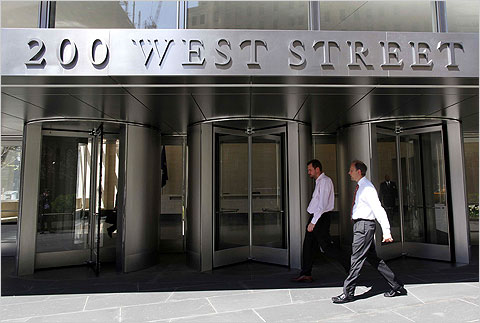
The Goldman Sachs global headquarters in Manhattan.